Online vs Offline
Online vs Offline Games: Which Should You Play?
Jul 6, 20266 min read
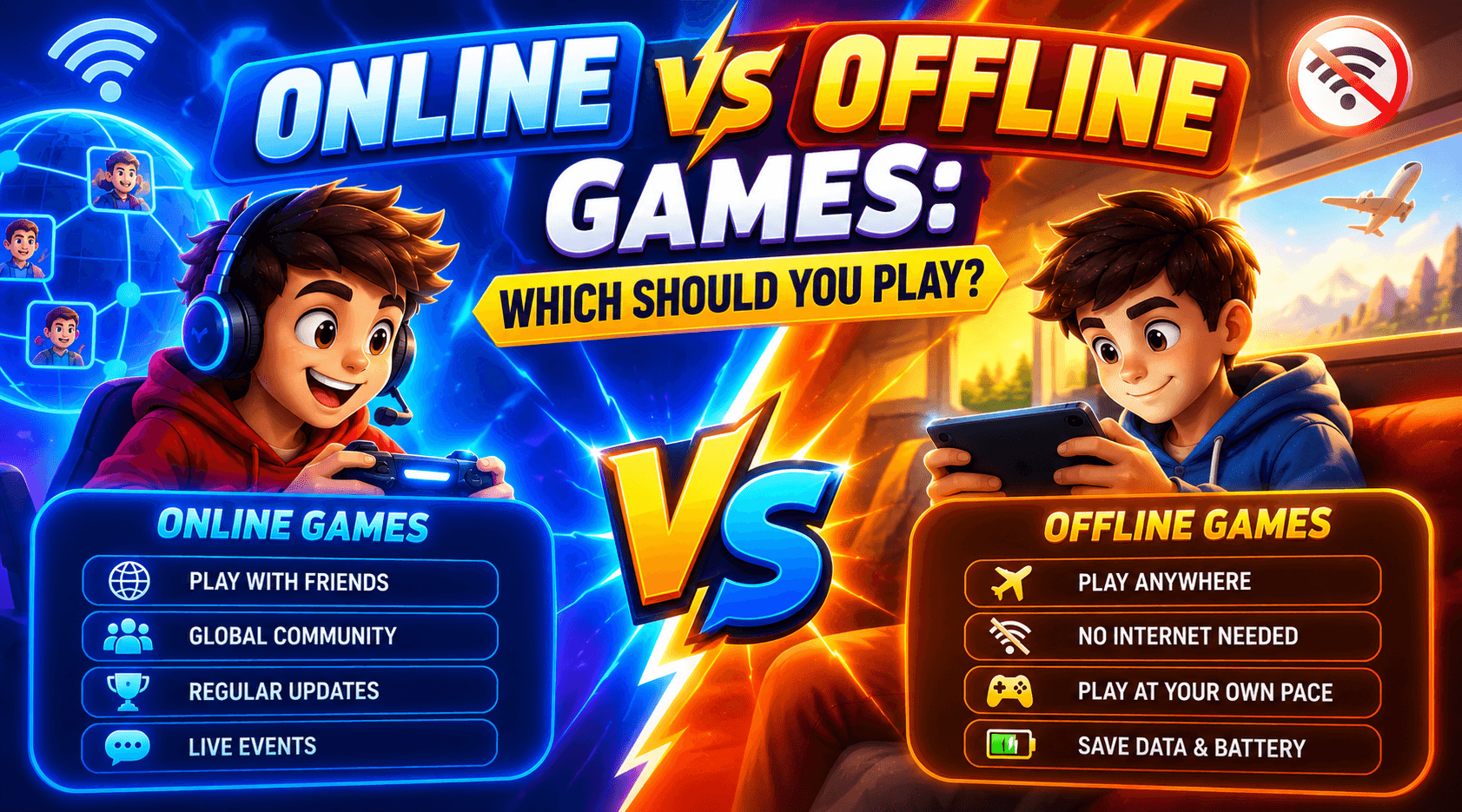
Multiplayer thrills or solo calm? A friendly breakdown of online and offline games — their strengths, their trade-offs, and how browser games give you both.
The core difference
At heart, the online-versus-offline question comes down to who — or what — you're playing against. Online games connect you to other people in real time: shared arenas, competitive matches, and lobbies full of unpredictable human opponents. Offline games are self-contained, pitting you against the game itself, whether that's an AI, a puzzle, or your own previous best. Neither is better than the other; they simply scratch different itches. Understanding the trade-offs helps you pick the right kind of game for your mood, your situation, and how much time and connection you've got to spare.
What online games do best
Online games shine when you want a living, social experience. Because your opponents are real people, every match is different, and the challenge scales naturally as players adapt and improve — no AI can quite replicate that unpredictability. There's a competitive thrill to climbing a leaderboard full of real names, and a social spark to playing alongside or against others, even strangers. Genres like .io games and multiplayer sports thrive on this energy. The trade-off is that online play needs a stable connection: lag, drop-outs or empty lobbies can get in the way, and you're relying on other people being around to play with.
What offline games do best
Offline and single-player games offer something online play can't: total control and zero dependence on anyone else. You can pause whenever you like, play at your own pace, and dive in even with a weak or absent connection. There's no lag to spoil precise timing and no lobby to wait for — just you and the game. That makes them perfect for relaxing, for focused challenges like puzzles and platformers, and for playing on the move. The trade-off is the flip side of their strength: the experience is fixed and solitary, so you miss the social buzz and endless variety that human opponents bring.
Browser games blur the line
One of the best things about modern browser games is that you don't have to firmly choose a side. The same site can serve up frantic online arenas and calm solo puzzles, all a click apart, with nothing to install either way. You might spend ten minutes battling real players in an .io game, then switch to a relaxing single-player platformer when you want to unwind — or when your connection gets patchy. That flexibility means your choice can follow your mood and your circumstances from one session to the next, instead of being locked in by what you happened to download.
So which should you choose?
The honest answer is: whichever suits the moment. Craving competition, variety and a bit of social buzz, with a solid connection to hand? Go online and jump into a busy lobby. Want to relax, focus, or play somewhere with unreliable Wi-Fi? A good offline-friendly game is the smarter pick. The beauty of free browser gaming is that you never have to commit — you can sample both in a single sitting and let how you feel decide. On PokiPix, both worlds are always open, so the only real question is what you're in the mood for right now.