Adventure games hide their best material just off the main path. Here's how to find it, and why being slow is a genuine advantage.
The good stuff is never on the main path
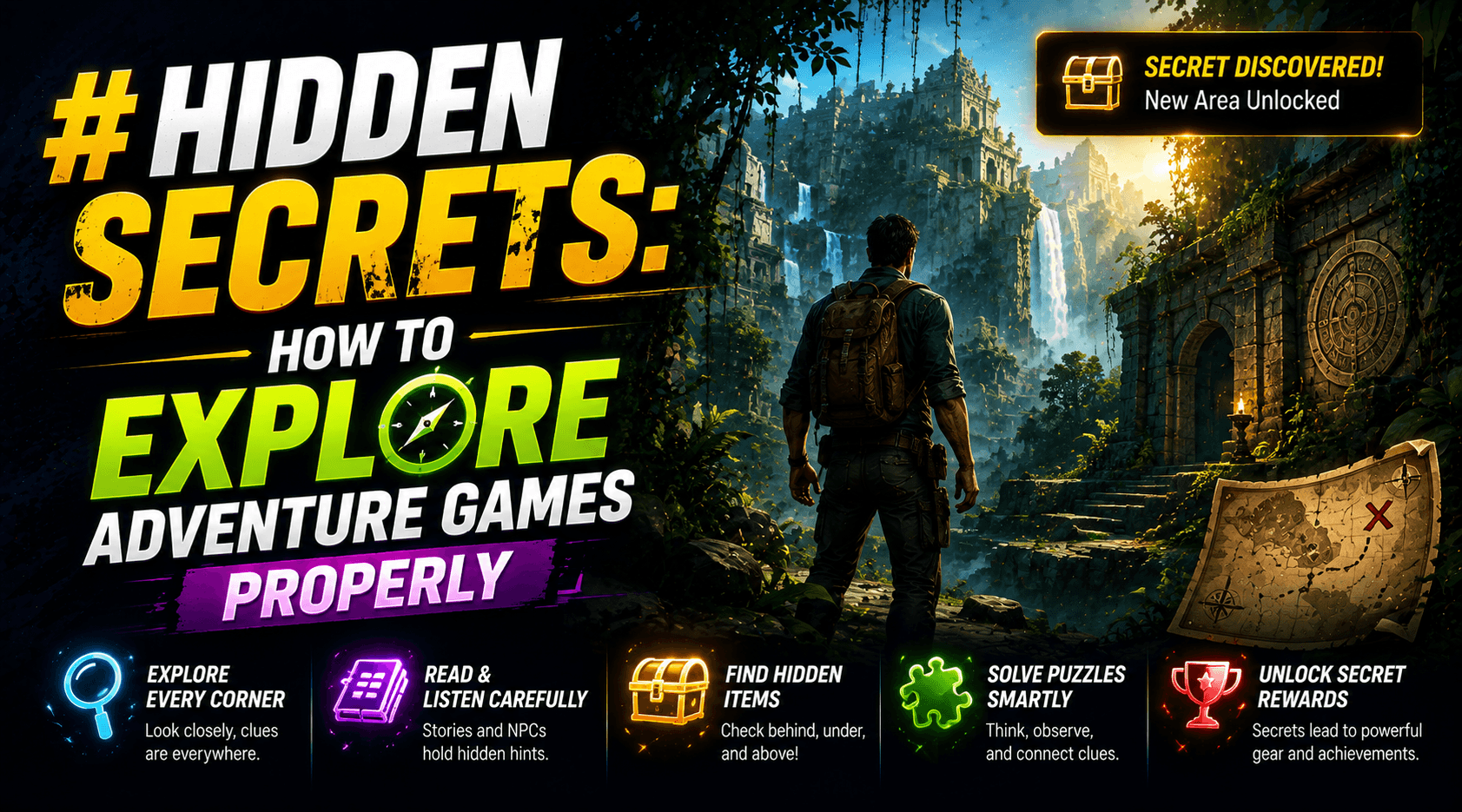
Adventure games are the one genre where taking your time is a competitive advantage. Designers deliberately place the most interesting material slightly off the critical route — behind a door you have to notice, down a corridor the camera doesn't point at, inside a room you had no reason to enter. Players who beeline for the objective finish the game having seen perhaps half of what was built for them. Searching the edges of every area before taking the obvious exit costs you a few seconds and consistently turns up things the game never told you were there.
Keep a list of doors you couldn't open
Every locked door, unreachable ledge and unexplained switch you pass is a breadcrumb. Adventure design assumes you'll remember them, because most of them become accessible once you find an item or ability elsewhere. Keeping even a rough mental list turns a confusing world into something closer to a to-do list, and it's the single habit that separates players who finish adventures smoothly from players who wander in circles. When you gain something new, the first question worth asking is which of those blocked paths it just opened.
A dead end is a message
When you genuinely can't progress, the game is almost never being unfair — it's telling you that you're missing something. Grinding at the obstacle rarely helps. Going somewhere else, finding the thing you didn't know you needed, and coming back is how the genre is designed to work. The same applies to puzzles that won't budge: adventure puzzles have a habit of solving themselves the moment you stop staring at them, so stepping away for a few minutes is a legitimate technique rather than giving up.
Interact with everything once
In a well-made adventure, a surprising amount of the scenery responds to you. Characters have more to say on a second conversation, objects reveal detail when examined, and environments frequently hide small rewards for curiosity alone. None of it is required to finish, which is exactly why it's worth doing — this is the material the designers made for players who look. Getting into the habit of poking at things costs almost nothing and turns a linear walk through a world into an actual exploration of it.
Start exploring on PokiPix
The Adventure category is full of free browser worlds you can wander at your own pace, with nothing to install and no account to make. Pick one, ignore the obvious exit for a while, and see what the corners are hiding. Because there's rarely a timer or a run to lose, you can stop anywhere and pick up exactly where your curiosity left off next time you visit.